
 EN
EN



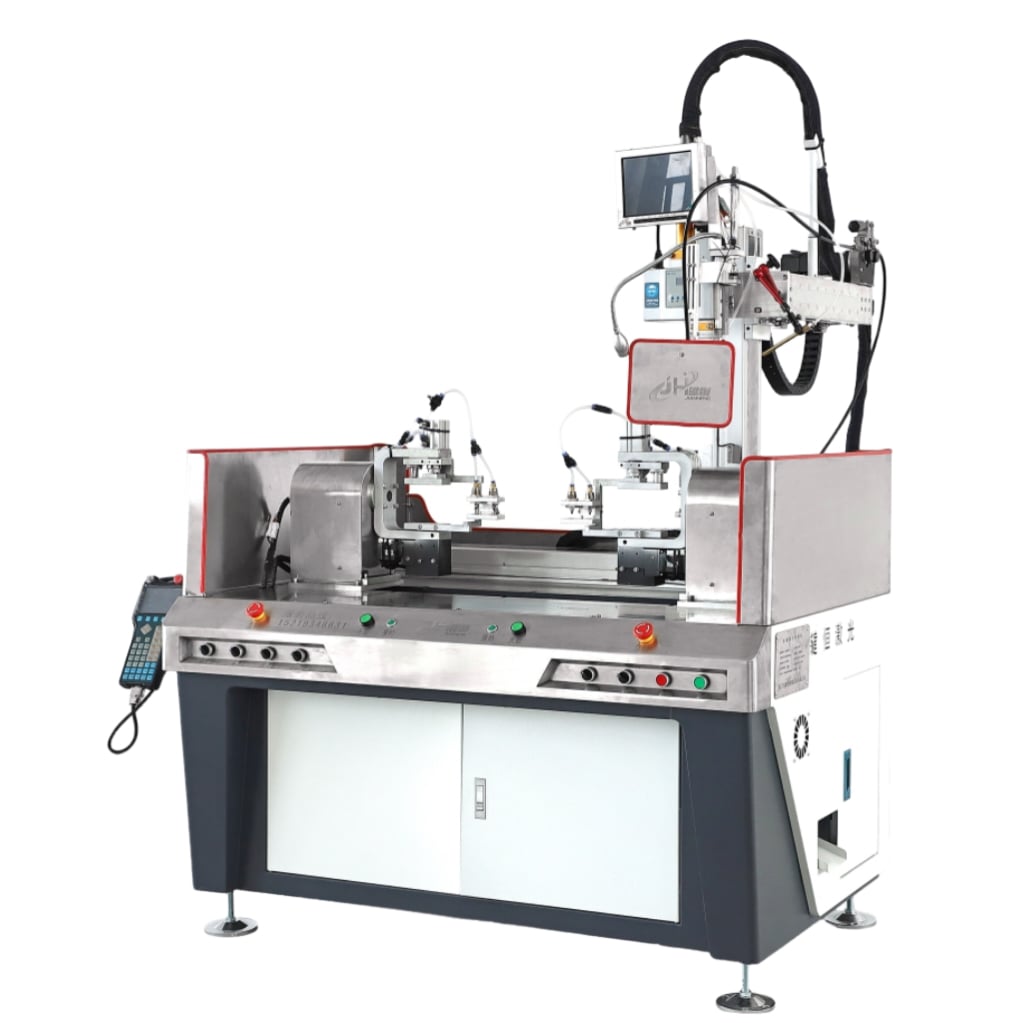
Understanding Heat Distortion in Automatic Laser Welding Machine
How Thermal Expansion and Contraction Lead to Weld Distortion
The heating and cooling cycles in laser welding often result in uneven stress buildup because parts heat up so fast but cool down at different rates across their surfaces. Take aluminum alloys for instance these metals have what's called a high coefficient of thermal expansion (CTE) and they can actually grow by around 2.4% when exposed to laser heat according to research from Material Welding Institute back in 2023. Combine that expansion with those incredibly quick cooling speeds sometimes over 500 degrees Celsius per second in automated production lines and manufacturers end up dealing with all sorts of residual stresses. These stresses then warp delicate thin gauge components, making them unsuitable for many applications where dimensional accuracy matters most.
Common Types of Welding Distortion: Longitudinal, Lateral, Angular, and Complex Warping
- Longitudinal distortion: Shrinkage parallel to the weld seam, typically 0.1–0.3 mm/m in stainless steel
- Lateral distortion: Perpendicular contraction resulting from steep thermal gradients
- Angular distortion: Misalignment caused by asymmetrical heat-affected zone (HAZ) formation
- Complex warping: Multi-axis deformation in assemblies with multiple joints, often exacerbated by unbalanced joint sequencing
Case Study: Measured Distortion in Manual vs. Automatic Laser Welding Machine Setups
An automotive component analysis found a 63% reduction in angular distortion when switching from manual TIG to automated laser welding. The robotic system maintained 0.05mm positioning accuracy, compared to ±0.2mm variance in manual operations, ensuring consistent energy delivery and reduced thermal imbalance (2024 Automated Welding Review).
Proactive Design Strategies to Identify and Mitigate Distortion Risks Early
| Strategy | Manual Welding | Automatic Laser System |
|---|---|---|
| Heat Input Control | Operator-dependent | AI-regulated pulsing |
| Cooling Management | Passive air cooling | Active gas-assisted quenching |
| Distortion Prediction | Trial-and-error | Computational modeling (FEA/CFD) |
Preemptive use of adaptive clamping algorithms and multiphysics simulation reduces rework costs by 38% in precision manufacturing, according to laser welding thermal management guidelines.
Precision Control with the Automatic Laser Welding Machine: Reducing Heat-Affected Zones
High Processing Speeds and Reduced Thermal Exposure in Automated Systems
Automatic laser welding machines achieve 40–60% faster cycle times than manual processes through synchronized motion control and optimized beam delivery. This reduces thermal exposure, preserving base metal properties—especially critical in heat-sensitive applications like medical device manufacturing.
Laser Beam Precision: Focus, Power, and Path Control for Minimal HAZ
With 0.1mm beam positioning accuracy, automatic systems enable precise heat application, producing heat-affected zones (HAZ) up to 70% narrower than conventional methods. Adjustable power output (500W–6kW) allows fine-tuning to material thickness, essential for aerospace alloys under 2mm.
Case Study: HAZ Reduction in Automotive Battery Tab Welding Using Robotic Laser Welding
A leading EV manufacturer reduced thermal distortion in 0.8mm copper battery tabs by 82% using robotic laser welding. At 150mm/sec travel speed and 0.3ms pulse duration, the HAZ was limited to 0.15mm, eliminating the need for post-weld grinding per automotive production benchmarks.
Optimizing Pulse and Focus Parameters to Limit Heat-Affected Zone Expansion
Real-time focal length adjustment maintains optimal power density despite surface variations. Materials engineering trials show that combining 200Hz pulse frequency with 70% overlapping spots reduces HAZ width by 35% in stainless steel compared to continuous wave operation.
Laser Parameter Tuning for Effective Heat Input and Distortion Control
The Link Between Heat Input, Residual Stress, and Material Distortion
Excessive heat input creates steep thermal gradients, causing differential cooling and residual stresses. Temperature differentials over 200°C/mm can generate stresses of 400–600 MPa in stainless steel welds. Precise control of power and speed reduces peak temperatures by more than 30%, significantly lowering distortion risks.
Key Laser Parameters Influencing Distortion: Power, Speed, Focus, and Pulsing
Four parameters directly govern heat input and weld integrity:
| Parameter | Effect on Distortion | Optimization Strategy |
|---|---|---|
| Power | Higher wattage increases HAZ size | Match to material thickness (e.g., 2 kW/mm for steel) |
| Speed | Faster travel reduces thermal exposure | Maintain ≥ 5 m/min for thin-gauge metals |
| Focus | Tight beam minimizes lateral heat spread | Keep ±0.2 mm focal depth tolerance |
| Pulsing | Low-duty cycles limit heat accumulation | Use 10–30% duty cycle for aerospace alloys |
Case Study: Managing Thermal Load in Aerospace Components Using Variable Pulsing
Aerospace engineers reduced titanium bracket distortion by 62% using variable pulsed laser welding. Alternating 5 ms high-power pulses (1.8 kW) with 15 ms low-power intervals (0.3 kW) enabled controlled cooling, achieving a 40% narrower HAZ than continuous wave welding.
Continuous Wave vs. Pulsed Laser Modes: Best Practices for Thin-Gauge Metals
Using pulsed lasers cuts down on total heat buildup by somewhere around half to three quarters when working with thin metals under 1.5 mm thick. This makes them really good choice for handling delicate materials that might otherwise get damaged. Take copper nickel alloys used in electronic components for instance. When set at about 500 Hz pulse rate, these lasers manage to keep the temperature between passes well under 150 degrees Celsius. That helps avoid unwanted warping issues while still achieving almost full joint strength at around 95%. Some automatic laser systems take this even further by constantly tweaking the pulse settings as they go along, responding to what they sense happening with the heat during actual operation. These smart adjustments make all the difference in complex manufacturing scenarios where precision matters most.
Automation Advantages: Consistency, Synchronization, and Real-Time Thermal Management
Reducing Process Variability Through Automatic Laser Welding Machine Integration
Modern automated systems can hit around 0.02 mm in positional accuracy, which cuts down angular distortion by about half when compared to what happens with manual techniques according to Ponemon's research from 2023. These systems basically take out all the guesswork regarding torch angles and how fast the torch moves along, so the heat gets distributed evenly throughout large batches. Take automotive battery modules for instance where consistency matters a lot. The real magic happens through those CMOS sensors that track seams while the process is happening. They constantly tweak the beam alignment during operation, stopping gaps from forming because those gaps just make things get hotter than they should be, leading to all sorts of problems later on.
Synchronizing Welding Parameters for Stable and Repeatable Thermal Output
Today's advanced controllers manage laser power ranging from 200 to 4,000 watts while adjusting pulse frequencies between 10 and 500 hertz, all synchronized with robotic speeds that can go as low as half a meter per minute up to 20 meters per minute. The system needs to respond within just 5 milliseconds to maintain proper control. Keeping things running smoothly means maintaining heat input under 85 joules per millimeter, which is really important when working with those delicate 304L stainless steel thin wall components. When robots reach the end points of their joints, the system automatically ramps down parameters so power drops to around 65 percent during these overlapping sections. This helps prevent those annoying craters that cause distortion problems in finished products.
AI-Driven Adaptive Control and Closed-Loop Feedback for Distortion Prevention
Thermal imaging data gets analyzed by machine learning algorithms that can actually predict when materials might start warping. These smart systems then adjust the focal spot size anywhere from 12 to 150 micrometers depending on what they see happening. Take aerospace manufacturing for instance where such an approach made a real difference. When applied to Ti-6Al-4V wing spars, it cut down distortion problems dramatically—from about 1.2 millimeters down to just 0.25 mm across those long 8 meter seams. For something like welding Inconel 718 turbine blades in multiple layers, closed loop PID controllers keep things cool enough between passes so temperatures stay under 180 degrees Celsius. This kind of temperature control is absolutely critical for maintaining structural integrity in high performance components.
Case Study: High-Volume Electronics Assembly Using Automated Laser Welding
A consumer electronics manufacturer reduced micro-warps in 5G antenna modules by 72% after implementing robotic laser welding. Preset sequences alternated 20ms pulsed spots (600 W) for gold-plated contacts with continuous wave (150 W) for aluminum shielding, keeping peak temperatures under 350°C. The system achieved 99.4% dimensional compliance across 2.1 million welds per quarter.
FAQ Section
What is weld distortion?
Weld distortion refers to the deformation or warping experienced by materials during the welding process, caused mainly by thermal stresses.
How can laser welding reduce distortion?
Laser welding reduces distortion by providing precise heat application, reducing the size of heat-affected zones, and maintaining consistent thermal outputs through automation.
Why is automation important in laser welding?
Automation ensures consistency, reduces manual errors, and keeps positional accuracy high, significantly cutting down on distortion and improving production quality.
What parameters influence laser welding distortion?
Key parameters include power, speed, focus, and pulsing—each affecting heat input and the potential for material deformation.

