
 EN
EN



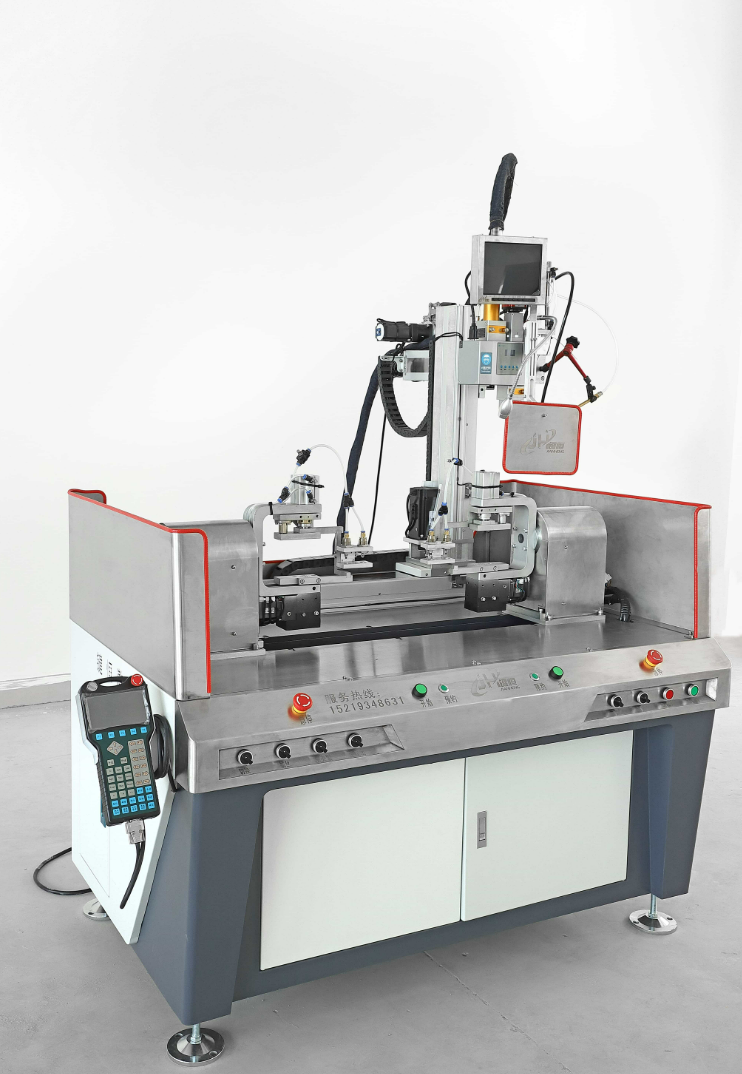
How Automatic Laser Welder Technology Enables Precision and Consistency
Automatic laser welder systems achieve unmatched precision through integrated automation and advanced optical control.
Integration with CNC and Robotic Systems for End-to-End Automation
These systems synchronize with CNC controllers and six-axis robots to execute complex welding paths with ±0.02 mm repeatability. Closed-loop feedback mechanisms adjust welding parameters in real time, eliminating manual calibration delays and reducing setup time by 65% compared to traditional methods (Industry Report 2023).
Core Components: Laser Source, Optical Delivery, and Beam Control
- Fiber laser sources: Generate 1,070 nm wavelength beams with <0.5% power fluctuation
- Dynamic focus optics: Maintain beam diameter consistency within ±5 microns across 3D contours
- Galvanometer scanners: Enable 15 m/s beam positioning for rapid seam tracking
A 2024 Laser Processing Study confirms systems with adaptive beam shaping reduce weld porosity by 92% in aluminum alloys.
Vision-Guided Alignment and Real-Time Part Positioning
High-speed CMOS cameras with 25 μm/pixel resolution map component surfaces prior to welding, while laser triangulation sensors track joint positions at 1,000 Hz. This dual verification system compensates for ±1.5 mm part misalignments during high-speed production.
Tooling and Clamping Design for Maximum Weld Accuracy
Vacuum-based fixturing maintains 0.05 mm flatness tolerance across 1m² work areas, critical for battery cell tab welding. Conformable copper alloy clamps dissipate residual heat, preventing thermal warping in thin-gauge materials during multi-pass welding operations.
Achieving High-Strength, Reliable Joints in Demanding Applications
Laser Welding Strength in Automotive Battery Manufacturing: Performance Data and Durability
Laser welders used automatically can create joints in lithium ion battery enclosures that are stronger than 450 MPa, which is pretty impressive when compared to regular resistance welding methods. The Journal of Material Science published this finding back in 2023. What makes these lasers so effective? They deliver energy right where it needs to go, making narrow but deep welds without messing up nearby parts that get damaged easily by heat. Car manufacturers have been testing these systems extensively too. Their results show around 98.6 percent success rate on the first try for welding battery tabs, even after going through over half a million temperature shocks ranging from freezing cold at minus 40 degrees Celsius all the way up to hot conditions at 85 degrees Celsius.
Precision Joining of Power-Dense Electronics With Minimal Thermal Impact
Keeping heat input under 35 J/mm is essential when using automatic laser welders because it helps maintain semiconductor integrity within power modules. At the same time, these systems can produce weld seams with surface roughness as low as 0.12 micrometers. The level of control makes all the difference for busbar assemblies where contact resistance stays consistently below 0.8 milliohms. This matters a lot for those high voltage 800V electric vehicle battery systems that need reliable connections. Modern equipment now features real time beam oscillation capabilities reaching frequencies around 2000 Hz. This feature actually works wonders for compensating small part variations during production, creating hermetic seals even when dealing with less than perfect surface conditions that are common in manufacturing environments.
Case Study: High-Strength Welds at Yangjiang Jianheng Intelligent Equipment Co., Ltd.
A leading Chinese manufacturer demonstrated 0.08 mm positional accuracy across 12,000 weld points daily in inverter production lines using vision-guided laser systems. Their hybrid aluminum-copper joints showed:
| Metric | Performance | Industry Average |
|---|---|---|
| Tensile Strength | 218 MPa | 185 MPa |
| Electrical Resistance | 0.15 μ·cm | 0.22 μ·cm |
| Process Speed | 82 cm/min | 55 cm/min |
Post-production testing revealed 99.4% joint integrity after 15-year equivalent aging simulations, validating long-term reliability in harsh operating environments.
Reducing Distortion and Heat-Affected Zones Through Non-Contact Processing
Advantages of Minimal Heat-Affected Zone (HAZ) for Joint Integrity and Material Properties
Laser welders automatically create joints that show about 40% less distortion than traditional arc welding methods according to Ponemon's research from 2023. They do this because they focus energy into beams just fractions of a millimeter wide. The result? Heat spreads only 0.1 to 0.3 mm into the material, which helps maintain the integrity of the base materials used in things like sealing lithium batteries or working with aerospace grade alloys. Looking at the numbers, the 2024 Materials Performance Report showed something pretty impressive too. When testing titanium joints welded with lasers, they kept nearly 98% of their original tensile strength after welding. That kind of retention matters a lot when dealing with parts that get stressed over time. And speaking of stress points, the minimal heat affected zone created by these systems stops several issues before they even start.
- Grain structure changes in nickel superalloys (reducing crack initiation points)
- Hardness variations exceeding ±5 Rockwell C in tool steels
- Plastic deformation in thin-gauge automotive panels
Non-Contact Nature of Automatic Laser Welder Systems and Compatibility With Sensitive Components
The absence of electrode wear or mechanical force enables welding of MEMS sensors and medical implants without surface marring. A laser processing study showed 0.002 mm positional repeatability when joining gold-plated connectors – impossible with ultrasonic methods. Key applications benefit from this non-contact approach:
| Component Type | Traditional Welding Risk | Laser Welding Solution |
|---|---|---|
| Glass-to-metal seals | Thermal shock fractures | Controlled 10–100 μs pulse durations |
| Polymer battery tabs | Material degradation | Near-IR wavelengths with <0.1% absorption |
| Microfluidic channels | Clamping distortion | Vision-guided seam tracking ±5 μm |
This process stability allows welding 500 μm-thin magnesium sheets without post-process stress relief – reducing cycle times by 65% in high-volume production.
Maximizing Speed, Efficiency, and Quality Control in High-Volume Production
High-Speed Welding Capabilities for Automated Manufacturing Lines
Modern automatic laser welder systems achieve cycle times under 0.5 seconds per joint, enabling seamless integration with high-volume production lines. This rapid processing speed supports throughput exceeding 1,200 parts/hour while maintaining positional accuracy within ±0.02mm, even for complex geometries like battery cell interconnects or power electronics housings.
Real-Time Monitoring and In-Process Quality Assurance in Automatic Laser Welder Systems
The latest welding monitoring tech brings together infrared heat imaging with spectral analysis techniques to keep tabs on how deep the weld goes and track cooling speeds at around ten thousand readings per second. When these systems spot something off, they tweak the laser power almost instantly – within just five milliseconds – which cuts down those pesky porosity issues by roughly two thirds when compared to older open loop setups, according to research published in Welding in the World back in 2025. Meanwhile, automated systems for following the weld path keep everything lined up pretty precisely too, staying within about fifteen microns of where it should be even during continuous round the clock manufacturing operations.
Defect Reduction by Up to 40% Through Data-Driven Process Control
Modern machine learning systems look at things like material certificates, how gaps form between joints, and past welding parameters to spot potential defects even before the welding process starts. Recent studies on optimizing mass production showed that combining automatic laser welders with smart energy adjustments cut down on spatter problems by around 40%. The system's ability to adapt reduces the area affected by heat in copper-nickel connections by approximately 22%, all while keeping strength levels well over 450 MPa. This matters a lot for industries where quality is non-negotiable, especially in making aircraft components and electric vehicle batteries where reliability can't be compromised.
FAQ
-
What are the core components of an automatic laser welder system?
They include fiber laser sources, dynamic focus optics, and galvanometer scanners. -
How does the technology ensure high precision?
Through integration with CNC and robotic systems, and real-time feedback mechanisms adjusting welding parameters. -
What are the advantages of using automatic laser welders?
They offer high-strength joints, minimal heat-affected zones, and compatibility with sensitive components. -
How do these systems contribute to quality control?
By providing real-time monitoring, defect reduction through data-driven controls, and maintaining consistent quality in high-volume production.

